May 28, 2026 | Access Mats
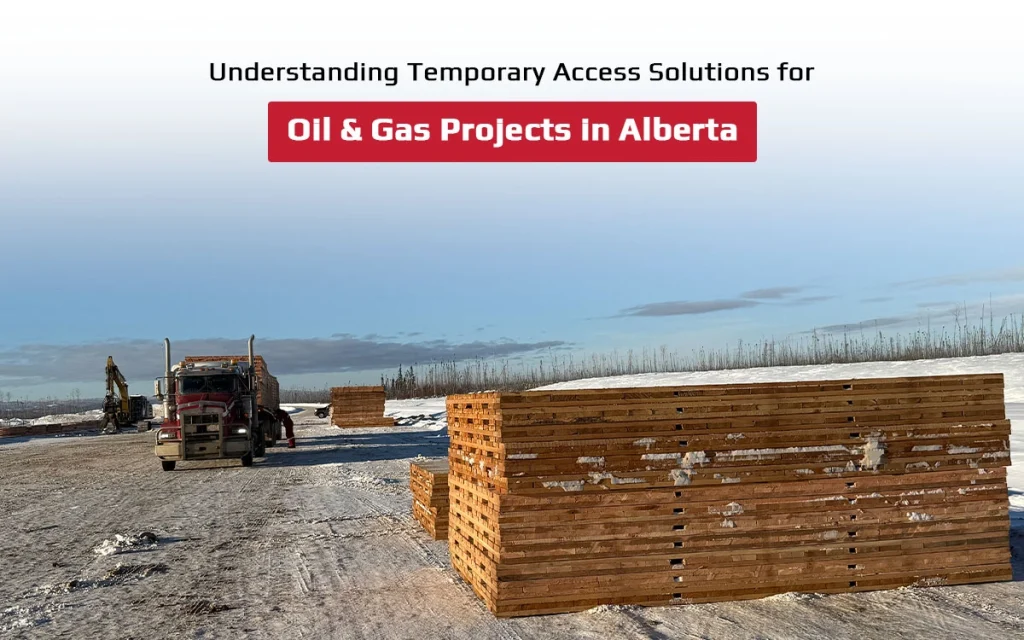
Oil and gas construction projects are common across Alberta and are often carried out in remote areas where ground conditions can be unpredictable. During activities such as drilling and pipeline installation, crews frequently encounter terrain that cannot adequately support heavy trucks, drilling rigs, and service equipment. When ground conditions are poor, project progress is often significantly slowed.
This is where project managers often depend on temporary access solutions in Alberta.
Access mats are essential as they allow machines and equipment to move safely across the construction site without causing damage. When contractors are working under tight timelines, as is common in the oil and gas industry, proper access planning can be the difference between delays and efficient project progress.
Why Oil & Gas Projects Require Temporary Access Mat Solutions
Oilfield operations are rarely carried out on prepared or constructed surfaces. Most drilling and pipeline work takes place in remote areas where infrastructure is minimal, requiring equipment and rigs to travel over farmland, muskeg, or undeveloped terrain.
Without proper planning, these conditions can quickly create major operational challenges. Heavy trucks and drilling rigs may become stuck in unstable ground, and site access for workers can become difficult and inefficient.
Access mats play a critical role in overcoming these challenges. By providing a stable and reliable surface, they allow equipment to move safely and help maintain steady progress throughout the project.

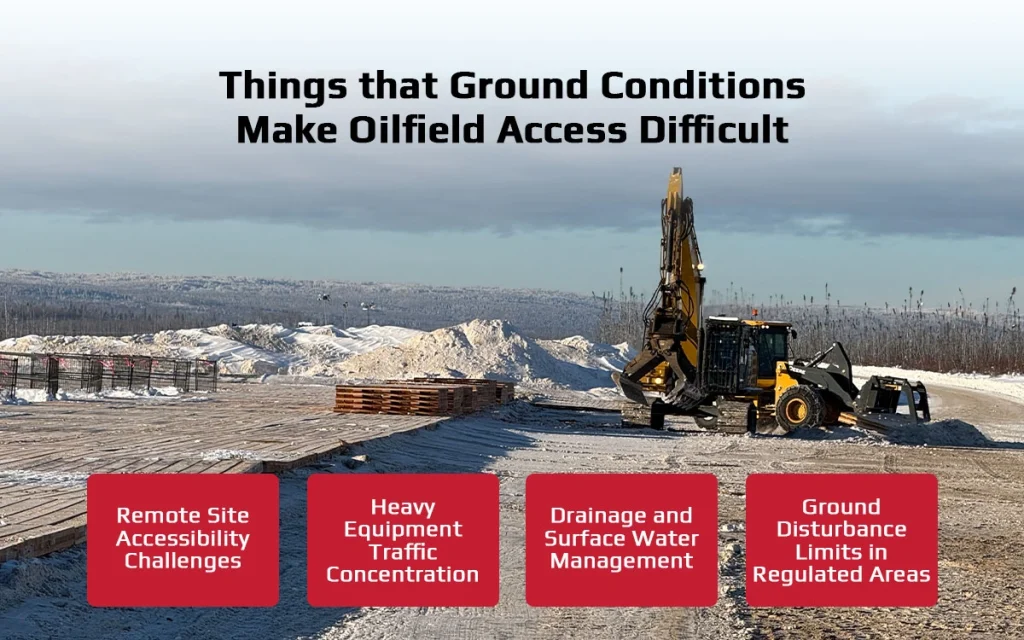
What Ground Conditions Make Oilfield Access Difficult in Alberta?
1. Remote Site Accessibility Challenges
Most oilfield projects take place in remote areas where there is little to no existing road access. Equipment often needs to travel long distances across undeveloped terrain before reaching the site. In these cases, the main challenge is not ground strength, but establishing a reliable path for equipment to reach the location.
Without proper planning, trucks can become stuck and equipment delivery may be delayed, disrupting the project schedule.
2. Heavy Equipment Traffic Concentration
Oilfield projects often involve repeated use of the same heavy equipment along a single route. Over time, this can cause the ground to deteriorate quickly, even if it initially appears stable.
Ruts begin to develop, water accumulates in low areas, and equipment mobility becomes increasingly limited. This problem is particularly common during extended drilling or pipeline installation operations.
3. Drainage and Surface Water Management
One common operational issue on energy projects is poor drainage. For instance, rainfall or snowfall can collect on access routes, making them slippery or unstable and slowing access vehicles.
Surface water management is essential to maintaining access to the site throughout the project’s lifecycle.
4. Ground Disturbance Restrictions in Regulated Areas
Some areas of the project sites may require strict control of access to the ground, which can be used in various ways. For instance, the contractor may be required to limit soil disturbance, designate areas of travel, or restore the land to its original condition after completing the work.
This means that access becomes an essential aspect of the preparation of the project, as opposed to an afterthought.
As a result of these operational challenges, contractors are relying on temporary access solutions used across Alberta projects to ensure the safety of equipment movement, ground conditions, and project schedules.
How Do Rig Mats Support Rapid Deployment in Oilfield Timelines?
Drilling operations require additional support due to the extreme weight and vibration produced by drilling rigs and associated equipment.
This is where rig mats play a critical role in oilfield projects. These mats are specifically designed to provide stability under heavy loads.
In oilfield projects, rig mats are used in various ways:
- For providing support to drilling equipment and other machinery used in the process.
- For stabilising service trucks and other support machinery.
- For creating safe working areas near drilling pads.
- For providing staging areas for equipment during construction.
Drilling activities involve continuous movement and heavy loads, which is why it is imperative to provide stable ground support to ensure safety and efficient operations.
Environmental Protection and Responsible Site Access
Environmental protection is a significant factor that needs to be considered for any energy project in Alberta. Construction of any kind in wetlands, forest, and agricultural regions demands careful planning to avoid disrupting the grounds.
Temporary access solutions help resolve these problems by establishing specific paths for travel. This helps reduce soil disturbance and limit the spread of equipment traffic across sensitive areas.
Through the concentration of vehicle travel on specific surfaces, oilfield access mats can be useful for:
- Soil compaction prevention
- Vegetation and ground cover preservation
- Erosion prevention, especially in wet conditions
- Promoting responsible access and site usage
Plan Smarter Operations with Dependable Temporary Access Solutions in Alberta
Oil and gas projects across Alberta demand dependable ground support to keep equipment moving safely and efficiently.
At GFI Solutions LTD, we deliver engineered access mat, rig mat and crane mat solutions that are designed to make demanding projects easier. Our systems support fast setup, durable performance, and reliable stability for both personnel and heavy equipment operating in challenging environments.
If you want to learn more about a practical temporary access solution for your next project, reach out to our team today!
FAQs
1. When are access mats needed in oilfield projects?
Access mats are required when heavy equipment must operate on soft ground, wetlands, farmland, or undeveloped terrain. They provide a stable platform that allows trucks and heavy equipment to safely access drilling sites.
2. How do access mats protect the environment?
Access mats enable the concentration of vehicle movements along specific paths. This helps in the protection of the environment since it minimises the disruption of the ground conditions.
3. What equipment can be used on access mats?
Access mats can support a wide range of oilfield equipment, including drilling rigs, service trucks, cranes, and other heavy machinery used in construction and maintenance operations.
Mar 2, 2026 | rig mats, Swamp Mats
Choosing the right mats for construction sites in Alberta goes beyond efficiency and cost—it plays a major role in site safety, ground protection, and long-term project success. From oil and gas pipelines crossing Alberta’s rugged terrain to large-scale wind farm developments and even the detailed demands of municipal infrastructure projects, selecting the proper matting solution matters. That’s why it’s important to understand the key differences between swamp mats vs rig mats in Canada.
In the blog ahead, we’ll take a practical, real-world look at how different mats perform across Alberta’s varied ground conditions. It’s important to understand that one mat isn’t necessarily better than the other—both swamp mats and rig mats have their own advantages and limitations, and each can be the right solution depending on the project.
We’ll compare cost versus performance, break down the key differences that influence jobsite results, and highlight the factors that make one option a better fit than another. The goal is to provide clear, actionable insights that help project managers choose the right matting solution with confidence.

What Are Swamp Mats?
Swamp mats in Alberta are specifically built for soft, waterlogged, or unstable ground. Made from heavy timber, these mats provide a stable working platform for vehicles, cranes, and construction crews, without the need for extensive site preparation.
They provide an even weight distribution on sensitive ground, preventing equipment from sinking into the ground and minimizing ground disturbance in wetlands, muskeg, and other soft soil conditions.
Key Features of Swamp Mats:
- Lightweight yet durable: easy to transport and deploy on site.
- Environmentally conscious: designed to protect wetlands and muskeg areas.
- Flexible on soft or uneven terrain: no heavy machinery needed for placement.
Swamp mats are ideal for temporary access routes, wetland crossings, and seasonal projects, especially when minimizing ground disturbance is a priority.
What Are Rig Mats?
Rig mats in Calgary are heavier-duty mats, traditionally made from thick timber planks, designed to support larger equipment and heavier loads. Often used in oil & gas, industrial, or heavy construction sites, rig mats can withstand freeze-thaw cycles and clay-rich soils common in Alberta.
Typical characteristics:
- Higher load capacity than swamp mats.
- Suitable for long-term or repeated use.
- Provides a strong foundation for cranes, drills, and tracked vehicles.
While more expensive upfront, rig mats can reduce downtime and repair costs by protecting both equipment and terrain.
Alberta Ground Conditions That Affect Mat Choice
Understanding Alberta soil conditions is critical when selecting between swamp mats and rig mats:
| Terrain Type |
Challenges |
Recommended Mat |
| Muskeg / Wetlands |
Soft, saturated soils |
Swamp mats Alberta |
| Clay-heavy Soil |
Freeze-thaw cycles are causing heaving |
Rig Mats |
| Rocky or uneven terrain |
Load distribution issues |
Rig mats / Heavy access mats |
Alberta presents unique construction challenges. Using the wrong mat type can delay projects, damage equipment, and increase environmental risk. Alberta presents unique construction challenges. Using the wrong mat type can delay projects, damage equipment, and increase environmental risk. That’s why all mat selections are guided by CSA standards and Canadian industrial compliance, ensuring every site meets safety regulations and operates within industry best practices.
Cost vs Performance Comparison

While swamp mats vs rig mats Canada are often compared solely on price, true cost analysis must consider performance, lifespan, and site-specific efficiency.
| Feature |
Swamp Mats |
Rig Mats |
| Intial Cost |
Lower |
Higher |
| Weight |
Lightweight |
Heavy-duty |
| Installation |
Easier |
Need Machinery |
| Durability |
Seasonal Use |
Long-term, high loads |
| Environmental Impact |
Minimal |
Moderate |
| Best For |
Soft ground, wetlands, temporary access |
Clay soils, heavy equipment, repeated use |
|
|
|
Best Use Cases by Industry
- Oil & Gas: Rig mats protect equipment and prevent delays caused by Alberta’s freeze-thaw cycles.
- Wind Farms: Swamp mats provide flexible access across wetlands with minimal environmental disruption.
- Pipeline Projects: Combination approach—swamp mats for soft sections, rig mats for heavy equipment staging.
- Municipal Works / Forestry: Swamp mats for short-term access, rig mats for heavier road stabilization.
For instance, the Alberta Clipper Pipeline project relied on rig mats in Calgary to stabilize equipment across clay-heavy soils, while a southern Alberta wind farm used swamp mats to cross seasonal wetlands with minimal environmental impact.
Swamp Mats vs Rig Mats – Understanding the Build Differences
Although swamp mats and rig mats used in Alberta are usually made of solid timber, there are many differences in their construction and specifications.
Rig mats are designed to carry heavier loads, with thicker timber planks and stronger construction to support cranes, drilling rigs, and track vehicles, particularly on clay-rich soil that is prone to the effects of freeze-thaw action in Alberta.
Swamp mats, on the other hand, are intended for weight distribution on soft or saturated ground, such as muskeg and wetlands. They are usually lighter in design, focusing on ground protection and temporary access rather than heavy-duty weight-carrying capacity.
It is essential to understand construction differences to enable project managers to select the appropriate solution based on terrain, load, and project duration.
In Conclusion
For Alberta construction projects, GFI Solutions LTD offers expert guidance, supply, and installation of both swamp mats and rig mats. Their mats are designed for Canadian conditions, including muskeg, clay soils, and freeze-thaw cycles, ensuring durability and reliability on every project. We also provide crane mats for rent along with permanent solutions, with full support for planning, delivery, and maintenance.
Whether you’re managing a renewable energy site, an oil & gas operation, or large-scale infrastructure, GFI Solutions LTD ensures your team has the right access mats for soft ground and heavy-duty mats to complete projects safely, efficiently, and on schedule.
Get Your Mat Recommendation Today and let us help you choose the perfect mat solution for your Alberta site!
Feb 25, 2026 | Uncategorized
Across Alberta, many projects operate miles from paved roads or stable grounds. Whether it’s an oil and gas site, a utility corridor, or a large infrastructure project, the work involved is critical. When the ground isn’t stable, it can slow progress and create serious safety risks for both equipment and workers. That’s exactly why companies invest in premium-quality swamp mats. They don’t just help create safe access routes but also protect the ground beneath heavy projects.
If you’re working on construction or heavy-load operations, this guide covers the key questions around swamp mats and explains how they help make Alberta worksites safer and more efficient.
What Are Swamp Mats and Why Do Alberta Projects Use Them?
Swamp mats are heavy-duty, three-ply wooden mats commonly manufactured in an 8’ x 14’ format. Built by securely fastening layers of 2” x 8” lumber together, they form a rigid, stable surface designed to distribute weight evenly across soft or unstable ground. This helps prevent equipment from sinking, reduces rutting, and improves safety and mobility for crews working in challenging terrain.
Across Alberta, many industries rely on swamp mats when operating in wetlands, remote locations, or undeveloped land where permanent ground solutions are not practical. By improving site access and minimizing ground disturbance, swamp mats provide an efficient and cost-effective way to support construction and industrial work while reducing environmental impact.
How Do Swamp Mats Compare to Crane Mats?
wamp mats and crane mats are both heavy-duty ground support mats, but they are designed for different load conditions and jobsite demands.
Swamp mats (access mats) are built to provide temporary roadways and stable working surfaces over soft terrain. Their primary function is to distribute rolling loads from vehicles and equipment to prevent rutting and sinking.
Crane mats are engineered to handle extreme, concentrated point loads — particularly from crane outriggers during lifting operations. They are typically thicker and structurally reinforced to resist bending and ground failure under very high compressive forces.
The key difference is not the material — it’s the load profile they are designed to support.
Swamp Mats vs. Crane Mats
| Feature |
Swamp Mats (Access Mats) |
Crane Mats |
| Core Function |
Temporary access & ground protection |
Lifting support & load stabilization |
| Load Type |
Rolling and distributed loads |
Concentrated point loads |
| Typical Equipment |
Trucks, excavators, loaders, dozers |
Mobile cranes, crawler cranes, piling rigs |
| Ground Conditions |
Soft, wet, uneven terrain |
Areas requiring high load stability |
| Structural Design |
Built to spread weight across surface |
Built to resist high bending and compression forces |
| Thickness (Typical Range) |
Moderate profile
5”-6” |
Heavier, thicker build
8”-12” |
| Common Use Cases |
Pipeline access, oilfield roads, site prep |
Bridge lifts, industrial lifts, heavy construction |
Which Industries in Alberta Depend on Swamp Mats?
Swamp mats are widely used across Alberta in industries that require safe access over soft ground, muskeg, mud, or environmentally sensitive terrain. They provide a stable working surface for equipment while reducing ground disturbance and preventing vehicles from getting stuck.
Common Alberta industries that rely on swamp mats include:
- Oil & Gas, where mats are used to build temporary access roads, support maintenance work, and improve site mobility in remote locations.
- Pipeline and Utility Construction, especially in undeveloped areas where permanent road building isn’t practical or permitted.
- Construction and Infrastructure Projects, where contractors need temporary access for equipment movement, staging areas, or bridge and road repairs.
- Forestry and Logging Operations, where mats reduce soil damage and improve equipment access during wet conditions or seasonal restrictions.
- Renewable Energy Projects, including wind and solar developments, where swamp mats help crews and equipment reach turbine locations, lay cable routes, and move materials across soft farmland or undeveloped ground without damaging the site.
- Environmental and Reclamation Work, where minimizing ground impact is critical for wetland restoration, erosion control, and remediation projects.
- Mining and Aggregate Operations, where mats provide safer travel routes and stable ground for support equipment in soft or uneven areas.
In all of these applications, swamp mats allow equipment to operate safely and efficiently while protecting the terrain below, reducing cleanup costs, and helping projects stay compliant with environmental regulations.
Is It Better to Buy or Rent Swamp Mats in Alberta?
Deciding whether to buy or rent swamp mats in Alberta or abroad depends on several factors, including project duration, available capital, tax strategy, storage capacity, and operational resources.
For many contractors, renting is the smarter short-term option. Renting requires no upfront capital investment, and rental payments are typically treated as a 100% tax-deductible operating expense. This makes renting financially efficient and straightforward. Renting is especially ideal for temporary or seasonal work, short-duration projects, or jobs where storage space is limited.
For long-term or recurring projects, purchasing mats can provide better overall value. While buying requires a higher upfront cost, ownership can significantly reduce long-term expenses and offers the flexibility to use mats across multiple projects. However, purchased mats are considered a capital asset, meaning they cannot typically be fully written off in the first year and must instead be depreciated over time.
It’s also important to consider the operational side. Companies that purchase large mat fleets often need to manage inventory, tracking, repairs, and logistics. In many cases, this becomes enough work to require a dedicated full-time role to manage the matting program.
To address this, we offer a Mat Management Plan that supports customers who want the benefits of ownership without the administrative burden. Our plan includes fleet tracking and coordination, mat washing, and even end-of-life trade-in, recycling, or disposal solutions, ensuring mats are properly handled from start to finish.
In summary:
Renting is often best for short-term projects and seasonal work.
Buying is typically the better choice for long-term projects—especially when supported by a complete
What Should You Check Before Choosing Swamp Mats in Alberta?
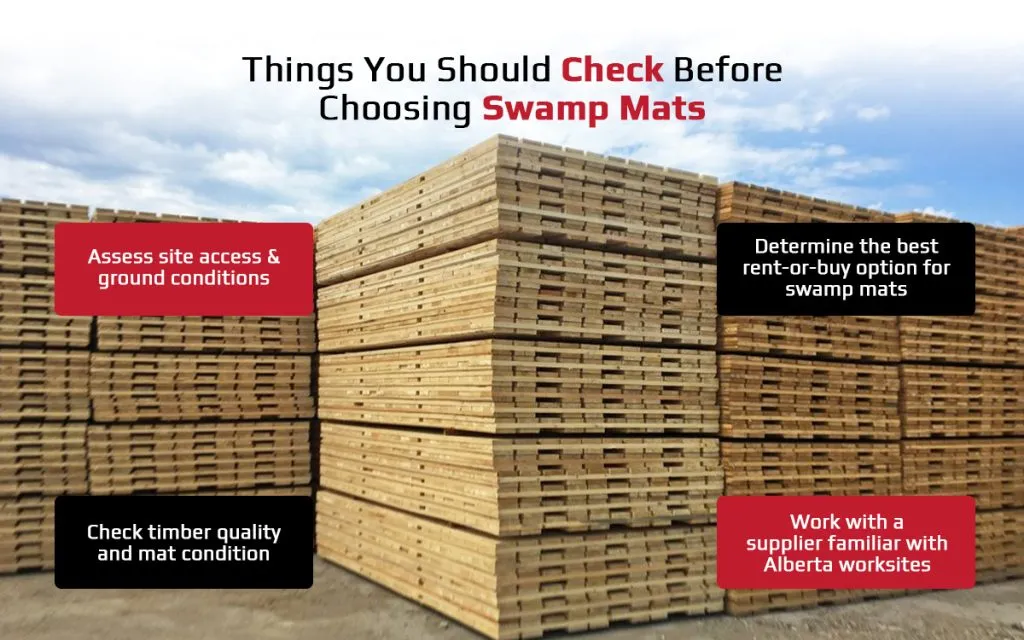
Although swamp mats offer solid protection, the right choice comes down to your specific site condition and intended mat usage. It is best to connect with a qualified swamp mat supplier in Alberta who can help you simplify the decision. They will help you identify what works best for your project. Here is the quick checklist you can follow:
- Review your site access and evaluate the ground conditions
- Decide whether you should rent or buy swamp mats that fit your budget scope
- Check timber quality and mat condition
- Work with a supplier familiar with Alberta worksites
Work Smarter on Alberta Terrain with GFI Solutions LTD
Access challenges shouldn’t hold your project back. With the right access solutions, Alberta worksites can stay safe, efficient, and environmentally responsible.
At GFI Solutions LTD, we offer dependable swamp mats for sale in Alberta and rental options that are designed for demanding terrain. With expert guidance and rental options available, we make access planning simple.
Get in touch with GFI Solutions LTD today to find the right matting option for your site.

Feb 20, 2026 | Uncategorized
Working on large job sites in Alberta often means dealing with soft ground, heavy machines, and tight safety rules. This is why ground protection mats are so important for maintaining workflow and work-related safety.
Often, the terms rig mats and access mats will be familiar in many teams, but the distinction between the two may not be.
Which one is stronger?
What works better for heavy machinery?
But which is most applicable in the Alberta environment?
Each of these issues represents a common concern of project managers, engineers, and field superintendents during project planning efforts.
This guide simplifies complex information to discuss the major differences between rig mats in Alberta and access mats. This publication aims to enable you to reply to some of your questions, such as:
- What is the purpose of a rig mat?
- What is the difference between a rig mat and an access mat?
- When should I use one over the other in my work environment?
Let’s clearly and simply break down the real difference between rig mats and access mats, so you can avoid costly mistakes on-site when selecting the correct option for your specific project.
What Are Rig Mats and What Are They Used For?
Rig mats are purpose-built, heavy-duty matting systems designed to support large-scale industrial equipment in demanding environments. Engineered to withstand substantial loads from drilling rigs, cranes, haul trucks, and other heavy machinery, they provide the structural integrity required to maintain safe and stable operations on active job sites.
Each rig mat is constructed with a reinforced steel frame and durable wood or composite inserts that distribute weight evenly across the surface. This design not only enhances load-bearing performance but also reduces ground pressure, helping protect soft or sensitive soil conditions while delivering a dependable working platform.
Common uses of rig mats include:
- Drilling rig pads (oil & gas and geotechnical drilling)
- Crane pads and lifting areas
- Heavy haul / truck access routes
- Temporary roads and work platforms
- Equipment staging and laydown yards
- Pipeline construction access and support areas
- Mining and quarry operations
- Wind turbine and renewable energy construction sites
- Substation and powerline construction access
- Wetland, muskeg, or soft soil stabilization
In the province of Alberta, where soft soils, muskeg, and seasonal ground conditions can limit equipment access, rig mats are used to distribute heavy loads safely and create stable, dependable working surfaces for industrial operations.
What Are Access Mats?
Unlike rig mats, access mats are constructed entirely from wood and are designed to provide a stable, cost-effective ground solution for lighter industrial applications. They are manufactured by bolting together three layers of lumber, with the top and bottom layers installed perpendicular to the center layer to increase strength and rigidity. A common configuration is the 11-21-11 board count, consisting of 11 (2x8x14’) boards on the top and bottom layers, and 21 (2x8x8’) boards in the middle layer. This creates a stable 8’x14’ temporary working platform.
Access mats create a solid working surface that allows vehicles, equipment, and personnel to safely travel over soft, wet, or unstable ground to reach work areas, structures, or construction sites. They are used in many of the same applications as rig mats, particularly where lighter equipment is required. Because access mats are significantly lighter and more economical than rig mats, they are one of the most commonly used matting solutions across industrial and commercial projects.
Their primary purpose is to:
- Distribute weight across a larger surface area
- Reduce ground pressure
- Prevent rutting and soil damage
- Improve safety and mobility on job sites
Access mats are lighter and more cost-effective than steel-framed rig mats, making them ideal for applications involving light to medium-duty equipment and temporary access roads.
While access mats provide essential ground protection and mobility, they usually do not offer the same load-bearing strength as rig mats. That means using access mats instead of rig mats in high-load situations can create safety hazards.
Rig Mat vs Access Mat: Key Differences
Why Choosing the Right Mat Matters
Choosing the wrong mat system can lead to:
- Delays in construction progress
- Ground damage and reclamation issues
- Operational risks for crews and equipment
- Higher cleanup or restoration costs
Understanding the difference between a rig mat and an access mat is critical, as incorrect terminology can create confusion and lead to selecting the wrong product for the job. Installing a standard access mat in an application that requires a rig mat can compromise project performance and equipment stability.
Are Rig Mats Used in Alberta Projects?
Yes. Many industries across Alberta—including oil and gas, forestry, pipeline construction, and renewable energy—rely heavily on rig mats to support safe and efficient operations. Whether a project requires access to remote locations, the construction of stable work pads, or travel across sensitive wetlands, selecting the right mat type depends entirely on the ground conditions and the specific demands of the application.
Ready to Choose the Right Mat for Your Project?
Choosing between rig mats and access mats becomes easier when site conditions and project requirements are clearly understood.
GFI Solutions LTD offers strong, reliable access and rig mats built for Alberta’s tough ground and demanding industries. Whether your project relates to oil, gas, construction, renewable energy, or emergency response, our team can ensure that you receive the right solution to your needs.
Contact us today to find the right access mats or rig mats for your Alberta project.
FAQs:
- What makes rig mats suitable for demanding applications?
Rig mats are built using a steel frame with timber inserts and are designed to provide stable support for lifting equipment, cranes, and heavy staging operations on challenging worksites.
- Can access mats be used for heavy equipment?
Access mats are commonly used to support vehicle movement and site access. When lifting or staging operations require additional support, rig mats are typically selected based on project requirements.
- How does ground protection differ between the two?
Both rig mats and access mats are designed to protect soil and vegetation by distributing weight and reducing ground disturbance. However, rig mats are commonly used in applications such as lifting and staging operations where additional ground support is required based on site conditions and equipment demands. Access mats, while effective for lighter loads, are typically used where ground pressure demands are lower.
Jan 14, 2026 | Timber Mats
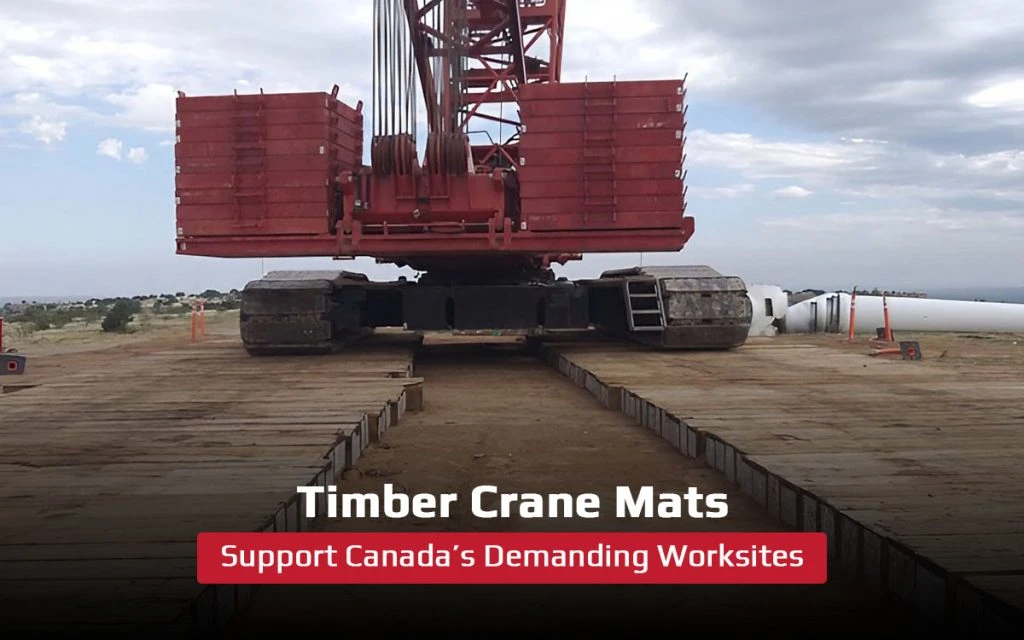
Canada’s construction and industrial sites often operate on demanding and unpredictable ground. It could be due to soft soil, an uneven surface, and ground stability issues. Such conditions can delay the project and add to its hazards. This is where timber crane mats provide a strong and stable base for heavy equipment, helping to reduce these challenges and keep projects moving safely.
Built from high-quality hardwood or fir timber, these mats are designed to support heavy loads while protecting the ground underneath. They serve a wide range of purposes across industrial worksites.
In this blog, we will highlight the top five uses of timber crane mats and explain why they are essential for major industries operating across Canada.
What Role Do Timber Crane Mats Play on Heavy-Duty Sites?
Crane mats are not like the average wooden access mats. Timber crane mats are built to handle heavy machinery and rough work sites. They are made from solid hardwood or Douglas fir planks bolted together that can efficiently handle and support crane outriggers or heavy equipment, even when the ground underneath is soft or uneven. Crane mats are commonly produced in heavy-duty dimensions that range from 8–12 inches thick, 4 feet wide, and 16–40 feet long. Their strong build makes them a go-to choice for tough industrial and construction jobs.
Here is why timber crane mats are chosen for heavy-duty sites:
- Thick timber planks distribute extreme loads evenly
- Wide mats provide stable platforms for equipment.
- Length supports cranes and large lifting zones
- Hardwood construction ensures durability in harsh sites
How Timber Crane Mats Are Used Across Canada’s Oil & Gas, Mining, Renewable and Infrastructure Sites
In Canada, the oil, gas, mining, renewable, and infrastructure sectors undoubtedly form a strong base upon which Canada’s economy is built, investing billions every year in critical projects. These projects require high-quality crane mats to ensure smooth, efficient, and productive operations.
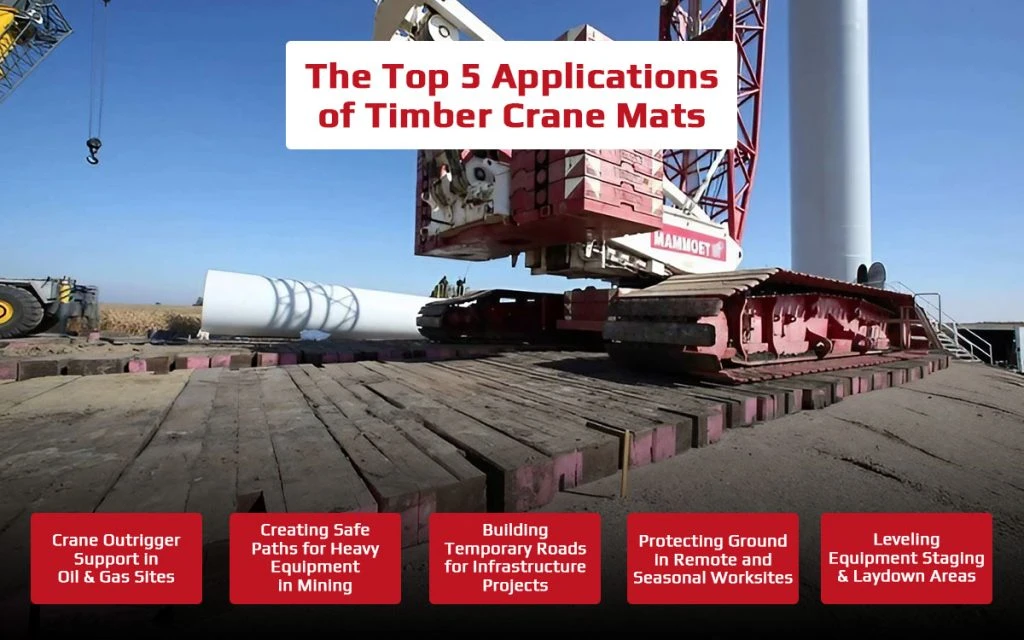
Here are the top 5 applications of timber crane mats across these industries:
1. Crane Outrigger Support in Oil & Gas Sites
In oil & gas projects, cranes are frequently used to lift heavy machinery and set up new equipment. Unfortunately, the ground is not always stable; this is where timber crane mats provide a solid and stable base. They prevent these heavy machines from sinking and reduce the risk of tipping on the uneven ground.
2. Creating Safe Paths for Heavy Equipment in Mining
The grounds in the mining sites are often uneven or loose due to constant shifting as the crews dig deeper. This makes it tough for loaders, excavators, and other heavy equipment to move safely around without getting stuck. Timber crane mats provide a stable, reliable surface. They help crews navigate the site smoothly while protecting the ground from wear or causing any further damage.
3. Building Temporary Roads for Infrastructure Projects
Across Canada, major infrastructure projects such as pipelines, bridges, and utilities require temporary roadways to move heavy equipment and machinery seamlessly. Here, crane mats can be used to hold up heavy traffic, even on soft or uneven ground, so that crews can easily move loads efficiently.
4. Protecting Ground in Remote and Seasonal Worksites
Remote locations and freeze-thaw cycles often make the soil unstable to bear heavy loads. Timber crane mats help spread the weight evenly, reducing rutting and wrecked terrain. In addition, they help in protecting sensitive areas such as underground utilities so that operations can be carried out safely even in tough conditions.
5. Leveling Equipment Staging and Laydown Areas
Large-scale construction projects—such as oil and gas, mining, renewable energy, transportation, and hydroelectric developments—often require temporary working surfaces for cranes and heavy equipment. Crane mats can be configured to create pads, access routes, or staging areas, providing a stable, load-bearing surface where permanent ground improvements are impractical or unnecessary.
Make Your Worksite Safer and Smarter with GFI Solutions LTD!
In demanding industries like mining, oil and gas, and renewables, smooth operations and safety go hand in hand. At GFI Solutions LTD, we offer reliable crane mats that are designed to support heavy machinery and protect workers on-site.
We provide both new and used crane mats, available for rent or purchase. With our high-quality access solutions, we deliver the support you need to keep your crew and equipment safe, even on the toughest worksites.
Explore our inventory today and get the right mats for your project!
FAQs
- What timber crane mats are mainly used for?
They help to support cranes, provide stability to heavy equipment, and protect the ground on uneven terrain.
- Are timber crane mats appropriate for the weather in Canada?
Yes, they work very well in wet soil and cold temperatures, as well as dynamic seasonal conditions, provided they are maintained properly.
3. How are timber crane mats different from steel-frame rig mats?
Timber mats are designed to handle concentrated loads, such as crane outriggers, while steel-frame mats are better suited for rolling loads and high-traffic areas.