
FAQs About Swamp Mats for Sale in Alberta: Everything You Need to Know
Across Alberta, many projects operate miles from paved roads or stable grounds. Whether it’s an oil and gas site, a utility corridor, or a large infrastructure project, the work involved is critical. When the ground isn’t stable, it can slow progress and create serious safety risks for both equipment and workers. That’s exactly why companies invest in premium-quality swamp mats. They don’t just help create safe access routes but also protect the ground beneath heavy projects.
If you’re working on construction or heavy-load operations, this guide covers the key questions around swamp mats and explains how they help make Alberta worksites safer and more efficient.
What Are Swamp Mats and Why Do Alberta Projects Use Them?

Swamp mats are heavy-duty, three-ply wooden mats commonly manufactured in an 8’ x 14’ format. Built by securely fastening layers of 2” x 8” lumber together, they form a rigid, stable surface designed to distribute weight evenly across soft or unstable ground. This helps prevent equipment from sinking, reduces rutting, and improves safety and mobility for crews working in challenging terrain.
Across Alberta, many industries rely on swamp mats when operating in wetlands, remote locations, or undeveloped land where permanent ground solutions are not practical. By improving site access and minimizing ground disturbance, swamp mats provide an efficient and cost-effective way to support construction and industrial work while reducing environmental impact.
How Do Swamp Mats Compare to Crane Mats?
wamp mats and crane mats are both heavy-duty ground support mats, but they are designed for different load conditions and jobsite demands.
Swamp mats (access mats) are built to provide temporary roadways and stable working surfaces over soft terrain. Their primary function is to distribute rolling loads from vehicles and equipment to prevent rutting and sinking.
Crane mats are engineered to handle extreme, concentrated point loads — particularly from crane outriggers during lifting operations. They are typically thicker and structurally reinforced to resist bending and ground failure under very high compressive forces.
The key difference is not the material — it’s the load profile they are designed to support.
Swamp Mats vs. Crane Mats
| Feature | Swamp Mats (Access Mats) | Crane Mats |
| Core Function | Temporary access & ground protection | Lifting support & load stabilization |
| Load Type | Rolling and distributed loads | Concentrated point loads |
| Typical Equipment | Trucks, excavators, loaders, dozers | Mobile cranes, crawler cranes, piling rigs |
| Ground Conditions | Soft, wet, uneven terrain | Areas requiring high load stability |
| Structural Design | Built to spread weight across surface | Built to resist high bending and compression forces |
| Thickness (Typical Range) | Moderate profile
5”-6” |
Heavier, thicker build
8”-12” |
| Common Use Cases | Pipeline access, oilfield roads, site prep | Bridge lifts, industrial lifts, heavy construction |
Which Industries in Alberta Depend on Swamp Mats?
Swamp mats are widely used across Alberta in industries that require safe access over soft ground, muskeg, mud, or environmentally sensitive terrain. They provide a stable working surface for equipment while reducing ground disturbance and preventing vehicles from getting stuck.
Common Alberta industries that rely on swamp mats include:
- Oil & Gas, where mats are used to build temporary access roads, support maintenance work, and improve site mobility in remote locations.
- Pipeline and Utility Construction, especially in undeveloped areas where permanent road building isn’t practical or permitted.
- Construction and Infrastructure Projects, where contractors need temporary access for equipment movement, staging areas, or bridge and road repairs.
- Forestry and Logging Operations, where mats reduce soil damage and improve equipment access during wet conditions or seasonal restrictions.
- Renewable Energy Projects, including wind and solar developments, where swamp mats help crews and equipment reach turbine locations, lay cable routes, and move materials across soft farmland or undeveloped ground without damaging the site.
- Environmental and Reclamation Work, where minimizing ground impact is critical for wetland restoration, erosion control, and remediation projects.
- Mining and Aggregate Operations, where mats provide safer travel routes and stable ground for support equipment in soft or uneven areas.
In all of these applications, swamp mats allow equipment to operate safely and efficiently while protecting the terrain below, reducing cleanup costs, and helping projects stay compliant with environmental regulations.
Is It Better to Buy or Rent Swamp Mats in Alberta?
Deciding whether to buy or rent swamp mats in Alberta or abroad depends on several factors, including project duration, available capital, tax strategy, storage capacity, and operational resources.
For many contractors, renting is the smarter short-term option. Renting requires no upfront capital investment, and rental payments are typically treated as a 100% tax-deductible operating expense. This makes renting financially efficient and straightforward. Renting is especially ideal for temporary or seasonal work, short-duration projects, or jobs where storage space is limited.
For long-term or recurring projects, purchasing mats can provide better overall value. While buying requires a higher upfront cost, ownership can significantly reduce long-term expenses and offers the flexibility to use mats across multiple projects. However, purchased mats are considered a capital asset, meaning they cannot typically be fully written off in the first year and must instead be depreciated over time.
It’s also important to consider the operational side. Companies that purchase large mat fleets often need to manage inventory, tracking, repairs, and logistics. In many cases, this becomes enough work to require a dedicated full-time role to manage the matting program.
To address this, we offer a Mat Management Plan that supports customers who want the benefits of ownership without the administrative burden. Our plan includes fleet tracking and coordination, mat washing, and even end-of-life trade-in, recycling, or disposal solutions, ensuring mats are properly handled from start to finish.
In summary:
Renting is often best for short-term projects and seasonal work.
Buying is typically the better choice for long-term projects—especially when supported by a complete
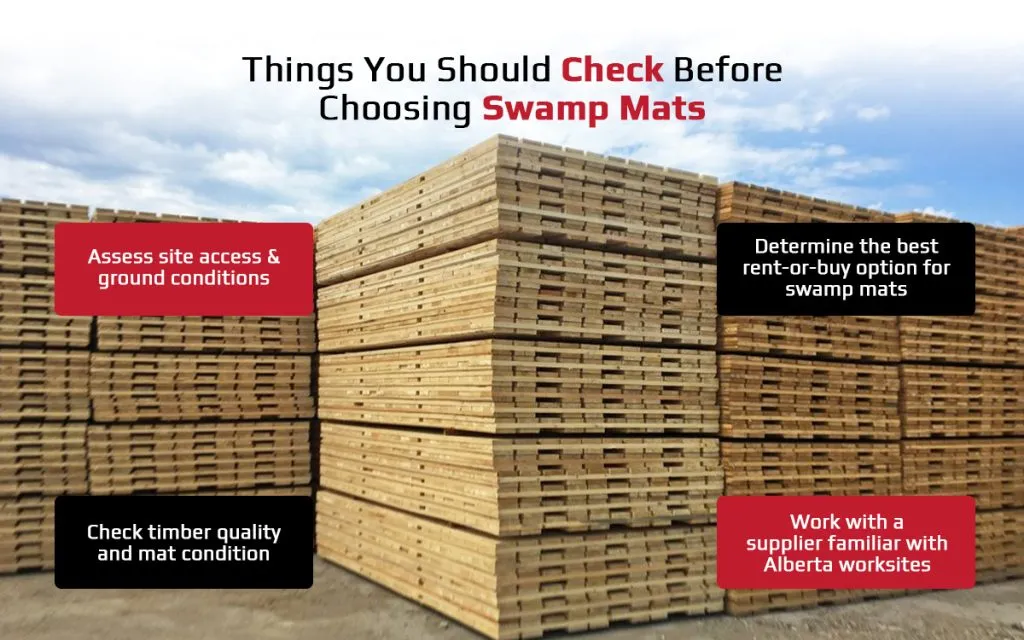
What Should You Check Before Choosing Swamp Mats in Alberta?
Although swamp mats offer solid protection, the right choice comes down to your specific site condition and intended mat usage. It is best to connect with a qualified swamp mat supplier in Alberta who can help you simplify the decision. They will help you identify what works best for your project. Here is the quick checklist you can follow:
- Review your site access and evaluate the ground conditions
- Decide whether you should rent or buy swamp mats that fit your budget scope
- Check timber quality and mat condition
- Work with a supplier familiar with Alberta worksites
Work Smarter on Alberta Terrain with GFI Solutions LTD
Access challenges shouldn’t hold your project back. With the right access solutions, Alberta worksites can stay safe, efficient, and environmentally responsible.
At GFI Solutions LTD, we offer dependable swamp mats for sale in Alberta and rental options that are designed for demanding terrain. With expert guidance and rental options available, we make access planning simple.
Get in touch with GFI Solutions LTD today to find the right matting option for your site.